Saturday, 1 August 2020

Autumn of the Patriarchs

Death threats, erotic whippings, far from ordinary scenes  ... eminent historian Michael King interviews PEN President and poet Kevin Ireland on writer politics in 1990. Why did Lieutenant-Commander Alistair Paterson, poet, threaten to kill the National President? Why did C.K. Stead, Professor of Literature want to beat up Creative Hub director Cranna? Was it over a woman? Was it the London flat affair? Hear the full recording here. Below, John Cranna offers a lightly fictionalised version ...

When he was sober, which wasn't that often, the National President-In-Waiting had some chilling news for me. We were hunched over the bar at Wellington airport, waiting for our flight north.

'Old Baldy would like to take out Young Baldy. Or to put it another way: Stead wants you dead,' he said.
Emeritus Professor C.K. Stead. Assassin in waiting? 
'Onomatopoeia,' I said.

'Assonance,' he replied.

He was a poet, I was a fiction writer. He knew about these things.

'Does he have a preferred method of dispatch?' I asked.

'Strangulation, suffocation, electrification. I don't think he's bothered.'

'The French have a term for that. Rime couee.'

'Yes. Very good. End rhyme. God knows why Stead came clean on this. The aggressor professor became a confessor,' he said.

Why an eminent professor of literature at Auckland University, and internationally lauded poet would want me maimed or dead was puzzling. I had just published my first book, a collection of short stories. I was something of a literary nobody, who had just been elected Chair of the Auckland branch of PEN aka The Society of Authors.

'And Alistair Paterson wants to kill me,' Kevin Ireland went on lugubriously.

'Lieutenant-Commander Alistair Paterson, Royal New Zealand Navy? The man who turned up to our meeting the other night in full ceremonial dress to recite his poetry. With a sword?' I asked.

He nodded. 'Yes. Have you seen the photo on his first poetry collection? He's holding an antique firearm. I'm taking the threat very seriously.'

'Why do these people want us dead?' I asked.

Kevin Ireland shook his head. 'Because we're changing things. It's the Autumn of the Patriarchs. They don't have long to live, and they can see it.'

We had just finished a harrowing four hour meeting of the writers' national executive (PEN) in the bowels of the National Library in Wellington, which Kevin likened to a meeting of the Central Presidium of the Soviet Union. In the chair was another rogue academic, a Professor of Russian Literature oddly enough, who had ruled the meeting with a bull-whip, and given us all thoughts of the Gulag.

Lnt-Commander Paterson (rtd). Poet & pugilist.
'What is it about these academics,' said Ireland thoughtfully. 'They all seem so unhinged.'

I pondered that one.

'But Alistair isn't an academic. He was in the Royal NZ Navy.'

'Another total institution,' said Ireland. 'Into which light rarely penetrates.'

'Yes,' I said. 'Those nematode worms that live in caves underground. They don't develop eyes of course. They're stuck there for life, so they get about by rubbing against things. They have a great sense of smell, however. Outside the caves they would be completely lost. But they're amazingly effective in their niche.'

Ireland nodded again. 'That's it. Niche-dwellers. The sooner we can get them out of our organisation the better.'

As it happened, left to his own devices, the Emeritus Professor got himself out of the organisation with amazing speed. That summer, operating under clandestine instructions from the Minister of Culture, and without telling any other writers on the national executive, Professor C.K. Stead flew to London and purchased a very expensive flat in Bloomsbury, in which he briefly installed himself, before advising New Zealand authors of his triumphal act.

Kevin Ireland. President. Extreme poet. Bibulant.
The short-coming in this admirable scheme was that he had written scathing reviews of the work of many of his peers, particularly a cadre of senior Wellington women writers, including Fiona Kidman and Lauris Edmond, and had shown regal contempt for the emerging Maori and Pasifika writers who were beginning to flourish at that time.

Stead, in short, had zero credit rating with his peers. Actually, his credit rating was lower than a nematode's tummy.

The result, from Wellington, was instantaneous. How dare the eminent professor make this purchase at the seat of Empire without consultation? How dare he ignore the many pohutukawa-ringed inlets on our own fair coastline that would make far more suitable retreats? This was cultural cringe of the most abject kind!!

Marshaling their impressive media resources, the Wellington matriarchs issued a stinging press release, dissociated themselves from this reckless act of colonial obeisance, and causing the Minister to have to answer some very tricky questions in Cabinet. The Minister, Michael Basset, was appalled, decided in the quiet of his own heart to exact long-term revenge on writers for his humiliation, and promptly sold the flat. The nation's journalists, always a little envious of their literary siblings, covered the debacle lavishly, and with smirking schadenfreude.

Michael King: Pacifier. Giant.
A little later, I chaired the meeting of Auckland PEN where the white-faced Stead was called to account.

He sat at one end of the room, ringed by the giants of the literary scene - Michael King, Maurice Shadbolt, Kevin Ireland, Dick Scott. Even journalist Sandra Coney, scourge of the patriarchs, was hovering in one corner, her notepad at the ready.

It was like Mount Rushmore made flesh. Granitic profiles abounded. Also present, so far as I could discern it, were the ghosts of Bloomsbury-dwelling Katherine Mansfield, Frank Sargeson, and John A. Lee. The court went into session.

'Um. Welcome, Karl,' I said. 'Now that Pandora's Box in Wellington is open, and the demons have been released, I wonder whether you would like to say anything?'

'Could we discuss this matter without resorting to dire literary cliche?' he said, fixing me with his ireful brows.

'Ok,' I said. 'I'll keep it simple. You've fucked things up. It's hard to imagine a more stupid act. You've infuriated the Minister of Arts and Culture, who will undoubtedly exact a terrible revenge on literature funding for decades to come. And through one act of hubris, you've created a lurid media carnival that has touched every writer in the country. I also understand from our President, that you have threatened to maim or kill me. Are there any other plans you'd care to share with us?' (Actually I only said one or two of those things.)

Mount Rushmore. Noble, granitic faces.
There was a deep quiet in the room. Stead looked surprised. No one had called him to account before. This was outside the domain of recognised natural phenomena. Beyond the academic cave system, into which no light penetrated, there were strange events that he barely comprehended.

Michael King coughed, in the tactful way that only he could. The country's pre-eminent historian spoke: 'I do think you have some explaining to do Karl,' he said. Michael's gentle, reedy, voice on that fateful evening still haunts me to this day. He had the capacity to settle any gathering of writers with his soulful, conciliatory manner. A couple of years later he was killed in a fiery car crash with his wife on the road from Coromandel, ending the dream of writer unity forever.

I could see Karl looking at Alistair Paterson in the corner, splendid once again in full naval dress regalia, complete with ceremonial sword. I could see Stead's eye alight on the weapon.

I thought to myself, 'Hari-kari, or murder?'

Sensing Stead's interest, Paterson quickly moved his hand to the hilt of the sword, securing it in its scabbard.

Dick Scott. Defender of the Chair.
I saw Dick Scott, who had witnessed his share of mayhem, and whose account of the invasion of Parihaka Ask That Mountain, had changed our view of our own history, edging around the room, to cut off a possible sally for the sword of the Lieutenant-Commander. I had tipped him off to intervene in the event of imminent violence. He was a friend, and I knew HE didn't want me dead.

Stead began his defense. 'Only the churlish would decline this opportunity,' he said, polishing his glasses furiously. 'How often does a Government offer writers a flat in a world centre of literature? We've chewed the hand of the Minister and shot ourselves spectacularly in the foot.'

'Mixed metaphor,' I shouted, and Stead visibly winced. This talk of fire-arms caused me to glance at the Lieutenant-Commander again. Dick Scott was hovering at his elbow.

The National President-In-Waiting got to his feet. Kevin Ireland was a tall man, with a deliberate, statesmanlike manner. Again, amazingly, he was sober.

'Baldy,' he said. 'Your pukeko have come home to roost. If you hadn't shafted Lauris and Fiona so often in the pages of the nation's review journals, you callous and calculating old c*** ...'

Lauris Edmond. Poet. Spear-carrier of the Matriarchs.
'Consonance!' I cried out from the Chair.

'Sub-case of consonance,' corrected Ireland, turning to me. 'Alliteration.'

He went on:  'If you hadn't riled every second writer in the land with your heartless, sulfuric reviews, you might have got away with it. As it is, by proceeding with this mad undercover scheme you have turned everyone against this organisation.'

The heads on Mount Rushmore all nodded sagely. It was like a mountain range springing to life. Stead looked around him desperately for allies. Paterson's jaw was jutting. Would the Navy intervene?

'Look Karl,' said the Lieutenant-Commander, his eyes smouldering orbs behind his tinted spectacles, 'Why didn't you take the time to get some dirt on Lauris and Fiona - extra-marital affairs, illicit bond-trading, off-shore accounts? You would have been in a safer position. To rile them in this way without leverage, without having something over them was, frankly ... ' the Lieutenant-Commander shook his head, sorrowfully, 'Negligent.'

I looked around the gathering. There was tacit consent. To enrage other writers so blatantly, without having some means of keeping them silent - blackmail - legal leverage - shockingly personal kompromat, as the Soviets called it ... was the height of foolishness. How could Stead, who was renowned for his cunning, wily ways, have made such a miscalculation? It was truly baffling.

Historian Dick Scott was holding his station: standing so close to the Lieutenant-Commander that I began to relax. Scott was a veteran of numerous bitter trade union struggles. It was unlikely the ceremonial sword, commandeered by an infuriated author would be used to assassinate the Branch Chair (me) or the National President (Kevin Ireland) despite the flurry of violent threats that was wracking the literary community that month.

I cleared my throat. I felt a little giddy. I stood up and spread my arms, feeling briefly like the statue of the Redeemer Christ overlooking the city of Rio de Janeiro.

'Perhaps this is an opportunity to heal some wounds,' I said.

I extended a hand to journalist Geoff Chapple on my left (he was about to conjure up a national pathway Te Araroa out of nothing and knew a thing or two about bringing a nation together) and to the tiny piano virtuoso and poet Denys Trussell on my right. Denys had a huge white beard and always wore a panama hat.

I faced Mount Rushmore. I bowed respectfully, avoiding Stead's eye.

'I would like us all to sing Kumbaya,' I said, and in a sudden moment of inspiration, 'But in Maori.'

I saw Michael King perk up. As a champion of the mana whenua, this bi-cultural gambit was right up his alley. And then I realised, with a sickening feeling, that he and I were the only two people in the room of forty-odd writers, who knew any Maori. (I had learned the tongue during three tumultuous years living in the head-quarters of Nga Tamatoa, the Maori Black Panther movement.)

But it was too late to pull back. As Branch Chair I had made my gambit, and to retreat now would signal a major loss of authority.

I struck out on the first few lines, in what I hoped would be a rich baritone voice, but which went soprano with apprehension. I was hanging onto Chapple on my left and Trussell on my right with a grim, claw-like grip. I saw them both wince with pain. Michael King came in behind me, in a deep, husky bass. The other writers in the room, taken by surprise, gripped the hands of those next to them, their eyes clouded with panic, their mono-linguality horribly revealed to themselves and to the others present.

Stead took this opportunity to bolt for the door.

I still remember him cannoning into the frame, so desperate to escape from the onslaught of a Stone Age Language Without a Written Literary Tradition. He put both hands to his ears, trying to block out the sound of the song, as Michael King and I began to ramp up our volume to compensate for our mute colleagues. With his hands to his ears, he couldn't open the door and fell against it repeatedly, in the end, collapsing in a heap.

'For God's sake someone let him out,' cried Kevin Ireland, and stumbled over to the door, which gave onto Stead's home patch, the English Department at Auckland University.

At the end of this grotesque recitation, there was sporadic applause. Sweat was running down Michael King's face. Dick Scott looked like a man frozen in time, still hovering by Paterson's sword. Maurice Shadbolt had disappeared in a cloud of fine blue smoke from his pipe, utterly baffled by proceedings. One of only a handful of women in the room, Sandra Coney was hunched in the corner, trying to stay away from this effluorescence of testosterone. Trussell held his panama hat against his chest, like a man at a funeral.

'Autumn of the Patriarchs.' Our President-In-Waiting's fateful words came to mind, the words that had been uttered with such prescience so many months before in the bar at Wellington airport as, refugees from the Professor of Russian Literature and alleged KGB admirer, we waited to fly north. I looked at the tweed jackets, the naval dress uniforms, the florid, avuncular faces and redolent pipes. The half-drunk glasses of horrific cabernet sauvignon. Only Shadbolt's shoes were visible now, such was the incredible volume of blue smoke surrounding him.

How had it come to this? An era was coming to an end; an era of jackets with leather elbow patches; elegant volumes of verse printed on embossed cartridge paper; web off-set presses and fanatical literary duels. I felt torn. In a way, I had helped bring it about: "The crisis consists of the fact that the old order is dying and the new order is not yet born. In the interregnum, a variety of morbid symptoms occurs." Antonio Gramsci's famous quote from his Prison Notebooks pounded in my ears.

Although they had not yet disappeared, I felt an intense nostalgia for the craggy monumentalism of these titans; their sheer Mount Rushmore-ness. It was my very respect, which they sensed, that had helped propel me to leadership. They had put their trust in me, as a young upstart with only a couple of books of fiction to my name. And then I had betrayed them, by helping usher in the new feminised world order. Within a decade, these Olympians were in wheelchairs, their pipes and tweed jackets hocked off to Opportunity Shops for Breast Cancer Fundraising, their slim volumes of arcane verse and dusty novels of men anguishing alone in the bush, relegated to the Deep Stack in libraries, below ground water level.

Michael King and I looked at each other, squinting through the atmospheric blue haze of Shadbolt's effluvium. We knew we were the Trojan Horses in the room ... 'A variety of morbid symptoms ... '

Men can read each other. We know who our enemy is. A hundred thousand years of evolution has trained us to identify our foe.

The room was in consternation. A schism had opened up. I glanced across at Sandra Coney. She looked down at her notebook, and then up at me. There was a glint of triumph in her eye. She knew which way the tide was running. She had seen the future of literature in this country, and indeed across the Western World. The colossi were being toppled. The Monstrous Regiment of Women was on the march and a thousand novels of unshackled domesticity, of omnipotent oestrogen beckoned. The future was fecundity.

Testosterone, at least in its Steadian manifestation, was toast.

Author's note: This is an extract from an upcoming novel, Palsy of the Patriarchs

Thursday, 14 May 2020

We are all Milanese

A blind man stands outside a cathedral in the deserted central square of a great city and sings.

And the whole world weeps.

Around him, in a city once vital and proud, men and women are dying.

Bocelli's Easter concert to a deserted piazza in Milano
They are dying alone, in the middle of the night with no-one to touch their hands, or to press a last rosary between their fingers. They are dying alone at dawn as their husbands and wives pray in solitude, a few kilometres away in shuttered houses and apartments.

They are dying at midday, as the April sun reflects off the stainless steel and glass of the wards in Milano's great hospitals.

Their spouses pray in the hope that their beloved of fifty years will be spared, and that a reassuring voice on the phone will quell their fears.

Throughout this city, white and orange ambulances thread their way along narrow streets and alleyways, bringing their cargo of the mortally ill to the doors of the Ospedale Luigi Sacco, the Ospedale Niguarda Ca' Granda, the Ospedale Pio Albergo Trivulzio, the Ospedale San Raffaele.

Alone, in the square, the duomo a towering, ornate backdrop, testament to the vision and brilliance of man's artistry, the solitude of this blind man reminds us of our own fragility and impotence before nature, of our own mortality. Of our brief passage on this earth, and of the fact that death can come to any one of us at any moment.

The world watches, transfixed, at the unfolding tableau.

Because we know that this is only the beginning; that the anguish of Milano is a glimpse of the future; of the suffering of many great world cities to come. That in the months ahead, we will all be Milanese, united in a brotherhood and sisterhood of grief.

And so this scene is as poignant as anything seen on earth since the 8th May 1945 - Victory Day at the end of World War II - because here we get our first glimpse of the unimaginable number of deaths to come.

And the blindness of Bocelli before the catastrophe, is the blindness of the world before nature.

The population of this great city and the towns around it are dying in such numbers because now and then nature, which we have subjugated to our will on a grand and ruthless scale, flexes and stirs, and reminds us that we are mortal, that we are here as her guests, and that our dominion over the earth is a tenuous, arrogant, and temporary thing.

When the earth slowed down, two months ago, and held its breath, the traffic stopped, and we started again to hear birdsong. We noticed the sky, suddenly blue, and its miraculous heart-stopping patterns. We started to listen to a new rhythm, and it was the rhythm of nature, that we have suppressed at our great cost. As men and women died in their tens of thousands all over the globe, at dawn, we saw light flooding the horizon, and that light was an invitation to a new beginning.

Perhaps the earth was waiting to tell us something. Perhaps at the heart of this catastrophe is a small still voice from the natural world that speaks to us if we wish to hear. It says: Your attack on nature; your relentless extinction of other species; your encroachment on the natural world of animals and their habitats; your expansion into vast cities, has brought you to this.

Take note.

As we witness the steady spread of the virus into the cities of the developing world; in Africa, India, and Latin America, into nations which have one ventilator for a million citizens, we are reminded once again that our fate is the fate of all humanity; and that in the century to come, our destiny will be indivisible from that of everyone on the planet.

And so every decision we take from now on; whether in our own lives, in the lives of our communities, or those of our political elites - will impact someone, somewhere, on the other side of the earth.

In 1624, as he was recovering from typhus fever, the English metaphysical poet John Donne wrote:

No Man is an Island:

No man is an island entire of itself; every man 
is a piece of the continent, a part of the main; 
if a clod be washed away by the sea, Europe 
is the less, as well as if a promontory were, as 
well as any manner of thy friends or of thine 
own were; any man's death diminishes me, 
because I am involved in mankind. 
And therefore never send to know for whom 
the bell tolls; it tolls for thee. 


Sunday, 8 March 2020

Chinese engineered Covid 19 to destroy my presidency, says Trump

John pays homage to Jonathan Swift and George Orwell

President Trump today alleged that the Chinese had genetically engineered the coronavirus to infect America, bring down the stock market, and thus undermine his presidency in election year.

He said he was initiating massive legal action against the virus, which would 'bring it to its knees.' He said that no expense would be spared in 'wide spectrum litigation' and the first law suits had been filed in the San Francisco Circuit Courts. His personal attorney, Jay Sekulow, who had been so effective during the Mueller Enquiry, would be leading the legal team arrayed against the virus. 'We will hound this organism. There will be no respite. We expect to have massive damages awarded against it,' said Sekulow.

Covid 19 - Unfairly maligned
In a remarkable about face, Professor Allan Dershowitz, who had previously represented Trump in the Senate Committee hearings against his impeachment, said that he would defend the coronavirus pro bono.

'This organism has been misunderstood,' he said today, from Harvard University, where he teaches. 'It was quite content to infect the bat populations of central China, but then was dragged out of its obscurity by circumstances beyond its control. It is basically a law-abiding, peaceable fragment of RNA, which has been maligned by the Establishment. Without quality legal representation, which I have offered the virus, it will simply not get a fair hearing.'

Dershowitz said his defense would rest on a new interpretation of the 'ignorantia legis neminem excusat' legal dictum. He said that the virus, being a primitive organism, could not possibly understand the damage that it could do, and thus any legal sanction against it was ultra vires.

Professor Dershowitz: 'The virus is innocent'
Sekulow's team, by contrast, are expected to argue that China's Military Agency of Genetic Warfare implanted a form of primitive intelligence in the virus, which is behind its rapid spread, and which renders it both responsible for its behaviour and culpable before the courts.

'This is one canny organism,' said Sekulow today. 'There is clearly malicious intent in its behaviour, and we intend to establish that it is a living, breathing entity that must be held accountable'.

Independent commentators point out that the virus has already done massive damage to China and the Chinese economy, and that this undermines the President's case.

In response, Jay Sekulow alleged today that the Chinese military lost control of the virus, that it 'went rogue' and that the intention to infect America was always evident.

The independent commentators say the case will probably rest on the crucial question of whether the virus is a 'self-aware, autonomous entity, capable of understanding the import of its actions.'

The head of the National Centre for Disease Control in Atlanta, Georgia, Robert R. Redfield, said he felt that the legal action against the virus was a diversion from government's primary responsibility - which was to protect the lives and health of citizens. 'We regret that this pre-occupation with punishing the organism in the courts, diverts resources and time away from a much more vigorous medical response that the government could be pursuing.'

NVA: Represents a range of pathogens
A conservative lobby group, the National Viral Association, which said it represents a range of biological agents, is backing the Dershowitz defense. The group, based in Des Moines, Iowa, said it supports a group of pathogens, from the H1N1 virus, to SARS and even MERS, which kills a third of those it infects. 'These so-called pathogens have a place in our community,' they said in a media release this week. 'We believe the American Constitution protects them. In the right hands they are often quite benign. Viruses don't kill people. Compromised immune systems do. Most deaths result from weak individuals who have allowed themselves to go to seed, or strayed from God's path.'

The White House said it was planning a range of counter-measures against the Chinese, including banning the consumption of noodles in U.S. restaurants; imprisoning pandas in U.S. zoos, and placing a massive tax on chop-sticks.

Dershowitz specialises in defending high profile clients, including the wealthy Danish socialite Claus von Bulow and football star O.J. Simpson, both of whom were charged with the murder of their former wives; Mike Tyson, Donald Trump and the convicted sex offender Jeffrey Epstein. Covid 19 is the latest among a string of clients whom Dershowitz maintains have been the victim of unreasonable prejudice.

The battle between these legal forces is hotting up, as the virus continues its spread throughout the world.

Thursday, 6 February 2020

Waiting for the Barbarians ...

In which John rashly pursues some thugs in a half-blind state.

When a group of men tried to kick down my front door in the small hours of Friday, 13th December in the seaside suburb of Bayswater, Auckland, it brought on a strong whiff of nostalgia for my former life on the other side of the world.

A colossal hammering woke me at midnight, and levitated me out of my bed, convinced I was having a nightmare. Then it came again. I ran to the door. 'What's up?' I called. No response. The noise intensified. 'What the hell is going on?' Peering through the stained glass window of my front door, I could see several moving shadows. This didn't seem like a friendly visit.

I rang 111, and my call was answered by an operator reassuringly called Wyatt.

In the comic books of my youth, Wyatt Earp was the sheriff of bad-ass Western towns terrorized by criminals. Wyatt wasted no time in racing to the scene, and dispatching the low-life with his Colt 45.

Wyatt Earp played by Kevin Costner in 1994 movie
This Wyatt didn't have such good news for me.

'All our cars are tied up on other incidents right now. But if things escalate let me know.'

'If things escalate, it might be a bit late,' I pointed out.

'We'll get there when we can.''

The hammering on the door came again. 'Did you hear that?' I asked.

'Yes, I did,' said Wyatt. 'It sounds a bit extreme.'

'That's how I would describe it.'

The police arrived two and a half hours later.

Twenty minutes after I got off the phone, one of the men ran at my door and gave it another huge whack. Through the stained glass window, I saw him run off.

The fact that he had turned his back triggered some primal instinct. I grabbed my squash racket, wrenched open the front door and, clad only in my boxer shorts, sprinted after the intruders.

I heard the sound of feet running rapidly down the street, and a flash of a yellow hoodie, barely visible, given I was half-blind without my contact lenses in. I raced after the men, waving the racket in an intimidating manner. After a few hundred metres of the chase, the intruders disappeared into the darkness.

I got into my car and drove around the neighbourhood, then staked out my house. After an hour, I went back to bed.

Half an hour later, the crashing on the door came again. They were nothing if not persistent, I thought. This time, I ignored them, which seemed to be what I should have done the first time. I had looked back at the end of my chase to see my front door wide open, light blazing into the night. A perfect invitation.

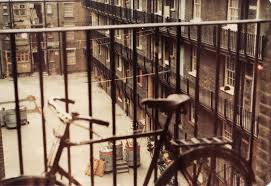
For the next hour or so I lay in bed, gazing at the ceiling and casting my mind back to my first job after leaving university in Wellington, which was as an estate manager in London's red-light district, Kings Cross.

My responsibility was to try to manage the heroin dealers and pimps on my estate - 'Kings Cross Estate of Shame' as Hillview was known in London's Evening Standard. Perhaps the most notorious estate in Camden, if not London. The estate acquired its name from the fact that it was located next to a vast ash-heap that had stood by the station in Victorian times.

I had a large metal box bolted to the back of the letterbox in my front door, as a precaution against a visit I anticipated from Sparky, aka Mr William Patterson. Sparky lived in the next stairwell and had acquired his name from his firebomb attacks on the homes of his competitors in Kings Cross.

He had flat eyes, a Glaswegian accent, and a pudding basin haircut.

His name was engraved on a large metal plaque that he had fixed to his front door. A stylish attempt to confer respectability on Kings Cross's most notorious and violent pimp.

I had a rope ladder under my bed, tied to the bedposts, so that I could scale down the side of my apartment block in case the metal cabinet failed to contain the anticipated inferno.

A dozen dealers and pimps, lead by Sparky, ran a network of prostitution and drug commerce on the estate, and my strategy was to watch the flat in question over a period of time, and then when the criminal was out, swiftly bring in a gang of workmen, and bolt a thick steel door to cover the existing one, and add steel shutters to the windows.

The dealer would return, find his squatted flat inaccessible to him, and go off to find fresh pastures. That was the theory at least. I deliberately spaced these evictions a few months apart, to lure the criminals into a false sense of security. I was keen to avoid them banding together to plan reprisals.

Sparky's right-hand man, Big Jo, was a cashiered member of the SAS who had served during The Troubles in Northern Island, and got about the estate in summer clad only in a pair of lurid green running shorts, with a machete tucked into his waistband.

The interior of Big Jo's flat was painted bright pink, to simulate, I imagine, brothel-like ambience. Unlike Sparky, who was ominously uncommunicative, Big Jo was a garrulous, friendly man, and I sometimes got chatting to him in the courtyards. He was quite open about his business activities, and I never knew whether he knew that I was plotting his demise. He once confided in me: 'I'm like a vampire, I only go out at night.'

Estate of shame
So it was at night that we made our move.

It took five years and a couple of trips to hospital before we got rid of these men. During that time I became acquainted with violence. Very acquainted. Anyone who enjoys violence on screen hasn't seen it up close. Up close it is messy and unpredictable. And profoundly corrupting of the human spirit.

Now, here in Auckland, Friday 13 December, I lay in bed unsleeping, alert to any new sound, smartphone and squash racket beside me, remembering those years with absolute clarity. I recalled that the most extreme violence could happen quite suddenly and was often over quite fast. You had to pay attention.

At 2.30am the police finally arrived.

'Do you have any enemies?' enquired the teenage bobbies.

I laughed in a hollow kind of way. 'How well do you know the literary scene?' I asked.

They looked a bit perplexed. 'Also quite a few in Kings Cross, London,' I went on. 'But I don't think they'd come this far.'

We discussed an ex-flatmate who I had evicted because of his drinking. They checked him on the police national computer and noted his drink-driving conviction. 'Hmm,' I said. 'I don't think its him. There was more than one.'

In fact, as I found out the next day from my neighbour Chris, who has witnessed the whole incident from his second story house, albeit also without his contact lenses in, there were four of them. One quite large, who had operated as look-out. My counter-charge with squash racket suddenly seemed about as smart as the Charge of the Light Brigade.

The large one had operated as a look-out, who clapped his hands as a signal for the gang to scarper.

I had once been the editor of a magazine with a lot of readers, and during that time had had one or two adversaries. I recalled, for instance, a furious letter from the head of the tow-drivers' association after I had run a series of satirical cartoons at the expense of the tow drivers' fraternity.

Towies are large men, who have been known to bear grudges.

I recalled, also, the outraged owner of a car and plane museum, which had accidentally filled a 1947 Studebaker with high octane aviation fuel for a road trip across the Southern Alps. As a result the car burst into flames at the pinnacle of the range, nearly incinerating me.

When I wrote about this, the museum owner angrily denied they had done any such thing, and threatened dire reprisals if the story was not withdrawn.

Even the most sweet-natured person can acquire a few enemies over a life-time. And regrettably, I couldn't recall anyone ever describing me as sweet-natured.

Death of a 1947 Studebaker
The next day a key piece of information came from another neighbour, Anthony a hundred metres away on Balfour Street. He had heard a similar hammering on his downstairs door the same evening. This suggested I hadn't been personally targeted, but rather that it was a random attack.

It was a relief to know that I could now sleep easily - easily, that is, until my next book review was published.


Monday, 23 September 2019

Unscheduled night up a tree ...

John gets lost on the remote island of 'Eua

There are only a handful of sign-posts on the Tongan island of 'Eua, and these are in pretty poor state after the 2018 tropical cyclone Gita, which damaged most houses on the island. On the vast majority of the island that is uninhabited jungle and farmland, there are no sign posts at all.

I had set out in the morning for the Fangatave cliffs and caves on the north-eastern tip of the island. I had done this hike a number of times, and on this occasion, as so often before, I was picked up by a Tongan family returning from church, and given a lift to the end of the Houma Road. After that, it is about a three hour walk through jungle and farmland to the spectacular cliffs and caves looking out to the Tongan Trench - the second deepest point on earth.

'Eua sign-post
It had been raining for the previous few days, and when I scaled down the cliffs to the cave system using a series of fixed ropes, I found myself stuck. Rain sluicing through the caves had made them slippery and dangerous, and any attempt to navigate them without a fixed line would result in me being spat out through caves to a ten-metre drop onto the rocks below.

I reluctantly turned back, because Fangatave Beach is pristine, deserted and miles from habitation - a truly beautiful location. It was late afternoon, and as I made my way back through the jungle and farmland, I noticed that logging of the forests had changed the topography, and paths I had previously recognised had gone. And then it began to rain.

I was clad in shorts, parka, and hiking boots, and soon my GPS smartphone got wet, and stopped working. After an hour or so, I realised I had taken a wrong turn and when my GPS briefly sputtered into life, I could see I was far to the south-east of my destination. Night was coming on, and no matter how much I looked for a track to take me to the west, I was drawn inexorably away from towns, to the uninhabited coast of the island.

Night time temperatures, mid-winter, on 'Eua had been about 17 degrees, and as the rain was getting stronger, and I didn't have a tent, the situation was looking unpromising. In the last half hour before darkness fell, I would need to find shelter. I had with me a bottle of water and a can of tuna. I would save the tuna for breakfast. The smart thing to do meanwhile was to wedge myself up a tree, away from the soaking ground, and trust the canopy to protect me from the relentless drizzle.

Top of the Fangatave cliffs
As night fell, I thought how rare it is to spend time in pitch darkness. In urban life, there is always a glimmer of light. In a forest, if there is no moon, the darkness is absolute. You cannot see your hand in front of your face. So black, that if I got out of my tree, I might not find my way back up it. So I wedged myself between the branches, and settled down. It was 6pm. Dawn would be in twelve hours.

Because I was wet, I curled into a ball. A drop of as little as two degrees centigrade in the core body temperature can be dangerous: Exposure is the biggest risk to wayward hikers. I also knew that I wouldn't be able to sleep; by moving all night, my muscles would generate heat and prevent my core temperature falling.

The first few hours were spent in an obsessive review of my situation … How had I been so stupid? Why hadn't I brought waterproof leggings? What would my buddies back at the Ovava Tree Lodge be thinking? It was a hike I had done many times before, so I hadn't even told them my destination.

Hotel 'Eua
I had only a few minutes of battery life left on my smartphone, and wanted to conserve that for a GPS reading in the morning - assuming it had dried out by them. But by midnight I knew that my friends at Ovava would notice my absence. I also knew they rarely answered their phone: A very 'Eua way to live. I reluctantly called 111, not because I wanted a police search - they would never find me - but because they could visit Ovava Lodge and let my friends know I was OK.

111 rang for a long time, then a woman's voice, with a thick Chinese accent said: 'This line is under maintenance. Please call back at a later time.'

I burst into laughter. I could imagine a Chinese company, contracted to supply emergency services, late in receiving kick-backs, deciding to withdraw services until whichever official in the local bureaucracy was responsible paid up. Tongans had told me the government is riddled with corruption.

Around 2am in the morning, I entered a trance-like state; a kind of meditation, in which I was detached from an anxiety that otherwise might have exhausted me. The next four hours were spent in this reverie, interspersed now and then with violent singing of tunes I composed specially for the occasion.

The keys I invented for my songs were new to mankind, and I hope never to hear them again. Small animals in the forest ran away in terror. My songs included a passionate hymn of praise to the sickle moon (which finally emerged around 3am); an appreciative song for the tree I was in - its bounty and gracious hospitality; and a wild and tuneless ditty about the importance of taking a sanguine view of things.

My biggest concern, aside from exposure, was that I would be too disoriented by sleep loss in the morning to find my way to the coast. An hour or two before dawn, I got out of the tree and lay on the soaking ground and tried to get some sleep.

Light flooding over the horizon at dawn was the most beautiful sight I could imagine. I carefully ate my can of tuna, using the lid as a spoon. Before it abandoned me, the GPS had signaled I needed to move due west ... I knew that if I started out at dawn, with the rising sun directly behind me, I would have a true compass direction.

After half an hour of dead ends, but having enough mental freshness to retrace my steps, I began to make steady progress westwards until I topped a ridge, and saw the sea – the 30km strait between ‘Eua and Tongatapu.

Moving towards the ocean, which was about three kilometres away, I came to successively bigger tracks, like tributaries. Finally I stumbled upon a workman’s hut, with oily abandoned overalls in it (warm clothing!). The sense of exhilaration I felt was indescribable - a surge of joy so deep, I felt giddy.

Buddhists say: 'Live with the Prince of Death at your shoulder at all times.' We should think about death daily, because only through this familiarity will we truly live each day in the present. While far from death, I had had enough of a glimpse of my own mortality to unleash in me the most profound gratitude for being on the earth - and simply breathing. I knelt down by the workman's hut and kissed the damp, sweet-smelling grass.


Thursday, 4 July 2019

My grandmother ... artiste with a shotgun

John remembers his mother of all grandmothers

Elsie was a small, bird-like woman, a former London school-teacher, whose house in Saunders Avenue, Morrinsville, was marked out with a large warning cross on the maps of the Waikato chapter of the Jehovah's Witness Church.

Something in her past had left her with a deep animosity to fundamentalist Christians, and when they came to her door, she would trap them on the porch, and deliver to them a harangue of such ferocity that they were often left white-faced and trembling, before she ushered them from the property.

In those years, before the Mormon Church sent its crisp-white-shirted emissaries door to door in small Waikato towns, the Jehovah's Witnesses enjoyed a prolonged ascendancy ... hawking copies of their magazine The Watch Tower, which was illustrated by terrifying cartoons featuring lurid threats of eternal damnation to the unbeliever.

(Strange but true fact: Jacinda Adern comes from a family of Morrinsville Mormons. History is silent on whether she ever encountered my grandmother.)

Elsie Beswetherick  had endured many things, including the death of two of her children in infancy, the death of her mother at the age of ten, and Zeppelin airship raids over London in WW I. She was known to have exterminated the rat population on her property in England with a shotgun, a weapon that was taller than she was, when she posed beside it with a sorry gaggle of slaughtered rodents.

Her son, Roger: "A single-barreled full choke 12-bore shotgun ... stood by the window in their bedroom, close to the hand of anyone overlooking the chicken run ...  The hens and their food attracted the occasional rat ...  One day I was mooching about in the chicken run, obscured from the house by apple trees ... there was the roar of the gun, a swish of shot and a stinging sensation in my forehead and arm.  A few flattened ricochets had struck me with just enough force to lodge in my skin.  What are you doing? Says I.  I’ve just shot a rat, shouts Mum! On another occasion, a plague of jackdaws was infesting the run at feeding time, accounting for a proportion of the chicken’s grain.  Mum caught the jackdaws clustered in the Victoria apple-tree ... The old gun roared, and nine jackdaws flopped to the ground."

She was a music teacher, had perfect pitch, and I still have her elegant Bannerman piano in my bedroom. A shot-gun-toting music-teacher seemed to me to be an ideal model for a grandmother - a perfect balance of yin and yang, of the masculine and feminine principles. Although ferocious in her attacks on rodents, jackdaws and Jehovah's Witnesses, to me, her oldest grandson, she was always gentle, unassuming and fun.

She had Cornish ancestry, and once a year, she would import fine red threads of saffron from Spain, and make a ceremonial batch of saffron buns; a Cornish traditional dish ... pale yellow, doughy and delicious.
Elsie and Stanley
When my grand-father, a man wrecked by WW I, an arduous life as a blacksmith, and grief for the loss of his home country, began crying eight hours a day, seven days a week, and was incarcerated in Tokanui Mental Hospital for a savage round of electric shock treatment, she maintained an imperturbable calm, as if he was on a prolonged business trip, and rarely if ever mentioned his absence.

When he returned, all Stanley could manage was to do was sit in the porch and knit scarfs, an incongruous activity for a massive ex-blacksmith, and in order to cheer him up, I would tell him my twelve-year-old's jokes, which sparked uncontrollable laughter, laughter that wracked his body until once again he broke into violent sobs, the tears falling onto his half-completed knitting.

Elsie, London school teacher to the core, wasn't keen on these open displays of emotion, and would chide him on misbehaving in front of his grand-children. I remember feeling a mixture of sorrow, pity, and a certain fascination at this spectacular disintegration of masculinity.

By coincidence, my own father, Elsie's son-in-law, was also a music teacher, and the whole question of what constituted real masculinity became a pressing question in our home in Morrinsville, stamping ground of the renowned All Black Don 'The Boot' Clark, and his famous brothers.

I compensated for this lack of masculine credibility in our men-folk by becoming a ferocious rugby enthusiast, playing at No 13 and was known for my kamikaze attitude to tackling. Sometimes, Elsie, a firm proponent of the principle that men should be men, would come to see me play, a tiny figure standing on the side-line and cheering me on - something my own father never did, lost as he was in his Bach fugues and Beethovian caprices.

Elsie with my brother, Andrew. c 1980
When Stanley finally died, and Elsie was incarcerated in a rest home in Hamilton with alleged Altzheimer's disease, I remained convinced during my teenage years, that her dementia was an act, that she had decided 'not to be a nuisance' and had gone quietly to the zombie domain of the aged and infirm rather than be a burden on the family, and that behind her octogenarian demeanor her school-teacher's mind was just as sharp as ever.

I shared this thought with my mother, Elsie's daughter, who looked first horrified, then strangely impressed, as though perhaps I had hit upon something. There was an element of self-abnegation among the women-folk in my family, as though conscious that their intelligence, self-awareness and complexity was not too highly valued in a woman in that era, and that it might just be smarter to play the game and go quietly into that good night.


Friday, 22 March 2019

Christchurch terror attacks - writers must respond

On John's election as national president of the NZ Society of Authors

Tēnā koutou katoa

We send love to our Muslim brothers and sisters at this terrible time.

New Zealand writers will always stand for tolerance and understanding in the face of barbarity and ignorance.

Writers through their work, can spread understanding of other cultures and faiths. They can celebrate the dignity and mana of these faiths and cultures. They can dispel hatred and fear.

They can show that the 'other', the foreigner, the immigrant, is just like us, with the same hopes, struggles and dreams. This can help combat the anti-immigrant rhetoric of political leaders who set people against each-other for their own ends, and who encourage and give legitimacy to racists and haters.

They can shed light on the corrupting role of violence and the glorification of violence.

The Ponsonby mosque in Auckland is opposite the Sacred Heart Catholic Church. Two days after the attack, the mosque was a fortress guarded by a huge Maori policeman and a tiny pakeha policewoman with loaded M4 carbines. A telling metaphor for the way Muslim communities in the West have often lived - islands in an alien sea. I could only leave my flowers outside the high walls.

A week later, things had changed. I passed the heaped up mountains of flowers left by Aucklanders, pungent but decaying, and was ushered into the domed room of the mosque by a smiling young man. I sat cross-legged on deep red carpet while the bearded imam, a Koran in one hand, reminded his flock, seated before him, that we are all living on borrowed time. He alternated Arabic with English. Above him, a huge red digital clock underlined his words.

I was aware of my own 'otherwise' in this holy place; how alien, how foreign I felt, a striking reminder of how awkward and out-of-place Muslims must often feel in our cities. I was inside the fortress looking out. I listened to the oratory for half an hour then left.

As I exited the mosque, another imam, Habib, stopped me and took my hand. He spoke of his long journey from Bangladesh, to Thailand and on to New Zealand. When I told him I was a Buddhist, he grasped my hand more firmly and smiled. 'In Thailand,' he said, 'Our friends the Buddhists lived such simple lives. They were very generous.' Perhaps out of tact, he didn't mention the genocide being perpetrated by the Buddhist majority against Muslims in neighbouring Myanmar.

Still, here were a Muslim and a Buddhist holding hands on a street outside a Catholic Church in a small country which has just been torn open by an unthinkable act of barbarity. In the wake of such terrible events, perhaps this was a little progress.

We can use these attacks to cross the moats between cultures and faiths. And we can take action as writers, too.

The greatest books of the last hundred years have opened our minds to the complexity of humanity, its miraculous variety and richness. Novelists in Africa, Asia and Latin America, and our own Maori writers have shown us how to understand and appreciate the marvelous diversity of humankind.

In 'Midnight’s Children', Salman Rushdie reveals in magical prose, the moment when the Indian sub-continent freed itself from the shackles of British colonial rule, and ran helter-skelter down a new, riotous and uncontrollable route to independence.

Ngugi Wa Thiong’o, the great Kenyan writer, writes from a jail cell, on toilet paper, and reflects on the emergence of a new democratic Africa from the rule of despots and tyrants.

Witi Ihimaera, Patricia Grace and Albert Wendt have shown how grievously neglected our own Pacific identity has been until recent decades, and how this marginalisation and neglect has diminished us all. Their books strike a rich new vein of cultural complexity that we New Zealanders can mine for our genuinely Polynesian future.

These books are narratives of emancipation and enlightenment. Of cultures emerging from the past and establishing something precious and new.

In the face of this richness, poetry and diversity, the writing of white supremacists is shown to be arid, impoverished, and destined for the dust-bin of history.

For ten years I lived and worked with immigrants in a poor and violent part of a foreign city. Many of them, Ethiopians, Chileans. Nicaraguans, Iraqis, had fled oppressive and cruel dictatorships. They were regularly vilified in the local media and by politicians as outsiders, parasites, free-loaders.

They were among the most brave, resilient and cheerful people I have ever met. They were thankful for the relative safety of their new home. They were grateful for the smallest generosities and the kindness of their host communities. Our Muslim countrymen and women here in Aotearoa remind me of them.

The Christchurch mass-killer posted an 87-page, 16,000 word manifesto on the libertarian website 8chan. It was lucid, spell-checked, and persuasive for those who desire to hate. It was a paean to medieval notions of racial superiority that informed the Christian crusades and animated a generation of Nazis in 1939.

Racist writers around the world, egged on by a new wave of populist politicians, echo Tarrant's message on their websites and in their chat rooms.

We must use our own skills as writers to counter these messages.

Writers are opinion makers, culture bearers and influencers. The best writers aspire to the highest standards of humanity. To what we all have in common. To our brotherhood and sisterhood with other nations.

We have much work to do in 2019.

Ngā mihi 

John Cranna